
1-805-484-2992
Quotes - Engineering - Sales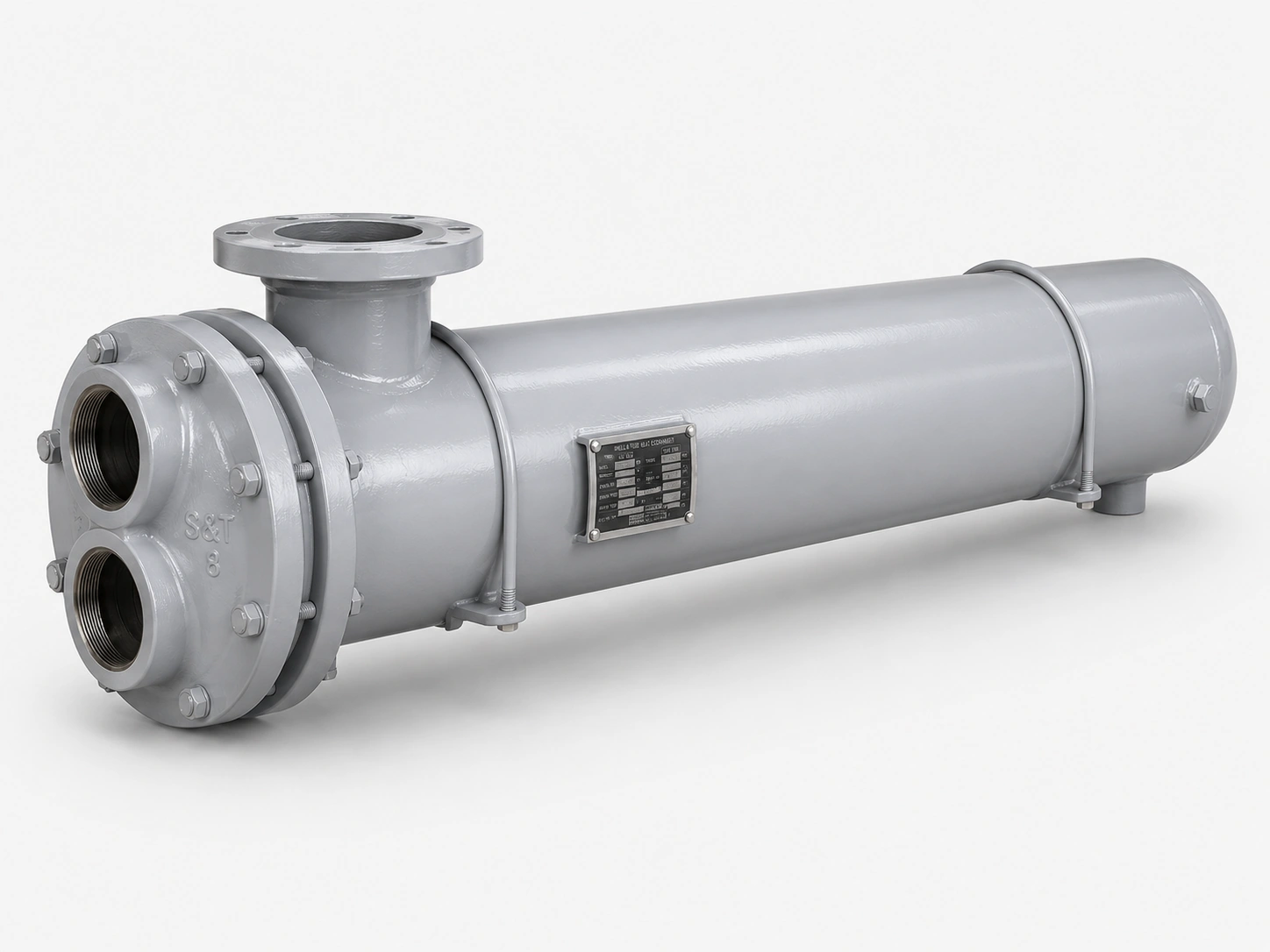
SU Series
| PRODUCT | TYPE | STYLE | RATING |
|---|---|---|---|
| Heat Exchanger | Shell & Tube | Steam-to-Liquid | 150 PSI / 375°F |
Specifications
Configuration & Size
Shell Diameter:
4" to 30"
Shell Length:
24" to 144"
Tubes:
3/4" O.D. Copper
Passes:
2, 4 and 6 Pass
Brand:
Bell & Gossett
Materials
- Bonnets: Cast Iron, Cast Brass or Steel
- Shell: Steel
- Tubes: Copper
- Tubesheet: Steel or Brass
SU Series Steam-to-Liquid Heat Exchangers
Steam in the Shell, Liquid in the Tubes
The SU takes steam on the shell side and heats liquid passing through a removable U-tube bundle. Steam condenses at essentially constant temperature, which makes the water side the controlling resistance and means the unit is sized on tube-side velocity and pressure drop rather than on anything happening in the steam.
Why the U-tube geometry matters here. Saturated steam meeting cold water is a large temperature difference by definition, and startup makes it abrupt. Each tube in a U-bundle is anchored at one end and free at the bend, so it expands independently and no differential load reaches the shell or the tubesheet. A fixed tubesheet unit on the same duty would need an expansion joint.
Condensate has to leave as fast as it forms. This is the single most common cause of an SU that appears to have lost capacity. When condensate cannot drain it floods the shell from the bottom up and progressively covers surface. Performance falls, the approach widens, and every symptom points at fouling. Check the trap, the back pressure and the drain leg before anyone pulls the bundle.
Pass count sets the tube-side velocity. Two-pass is standard; four and six pass arrangements raise velocity where the flow rate alone would leave the tubes laminar. Each additional pass buys heat transfer at the cost of pressure drop, and the part number records which arrangement a given unit carries.
Reading the part number. A catalogue number such as 5-260-04-060-011 encodes the series group, the shell diameter, the shell length and the pass and connection arrangement. The older SU45-2 style designation describes the same unit. Both forms appear on nameplates, and either one is enough for us to identify what you have.
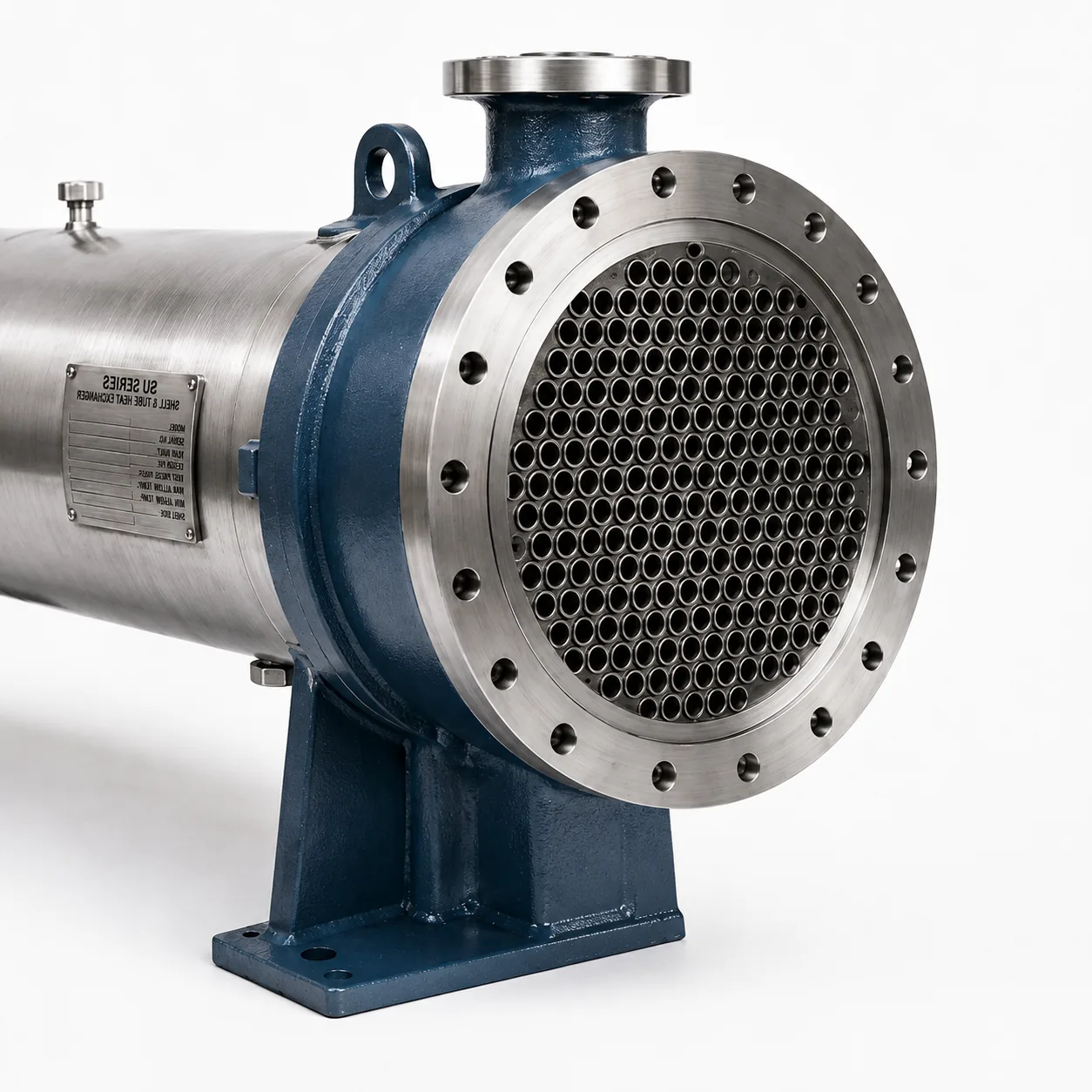
Steam in the shell, liquid in a removable U-tube bundle. Shells from 4 to 30 inches, rated 150 PSI and 375°F.
Request a QuoteSU Series Applications


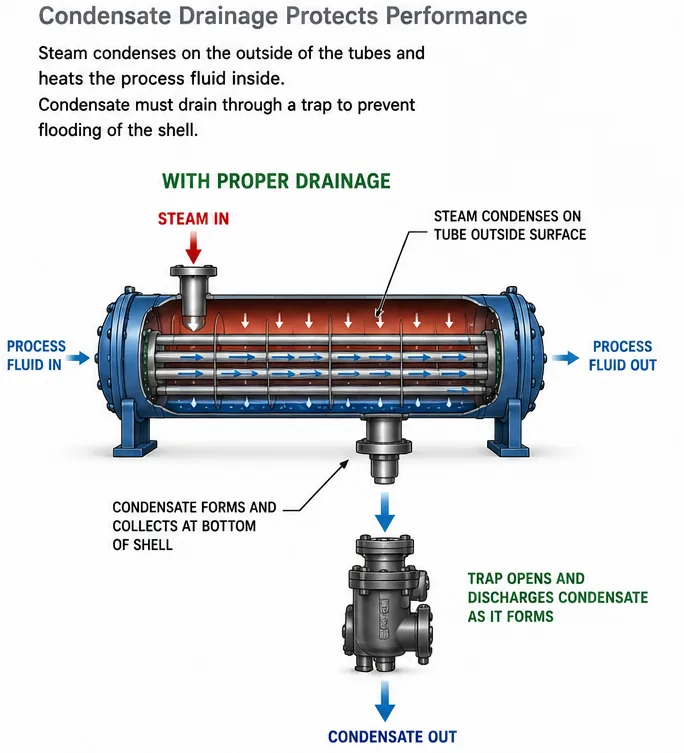
Condensate Drainage Decides How an SU Performs
Steam condenses to a fraction of its volume, and that condensate has to leave the shell as fast as it forms. When it cannot, it backs up from the bottom and progressively covers tube surface. Capacity falls, the approach temperature widens, and every symptom points squarely at a fouled bundle. On steam converters this is the single most common cause of what looks like an undersized exchanger.
Two things cause it. The first is a trap sized for the running load rather than the startup load: on a cold start the unit condenses steam at several times its steady-state rate, because the whole water volume and the metal mass have to come up to temperature. The second is stall, where a modulating control valve throttles shell pressure below the pressure in the condensate return line at low load. Condensate then physically cannot drain, and control becomes erratic in a way no amount of extra surface will fix.
Neither is an exchanger problem, which is why both are worth checking before anyone pulls a bundle. Send us the minimum load as well as the design load and we will tell you whether the duty runs into the stall region, and what the trap has to pass on a cold morning. Call and talk it through with an engineer: 1-805-484-2992