
1-805-484-2992
Quotes - Engineering - SalesSelection Support
Engineering
and Selection
A shell and tube selection needs six numbers to be made properly and eight to be made reliably: flow rate, inlet temperature and required outlet temperature on each side, plus the allowable pressure drop on each side.
That last pair is the input most often left off an enquiry and the one that most often changes the answer. A unit can meet the thermal duty exactly and still be wrong, because the pump in the system cannot push the design flow through it.
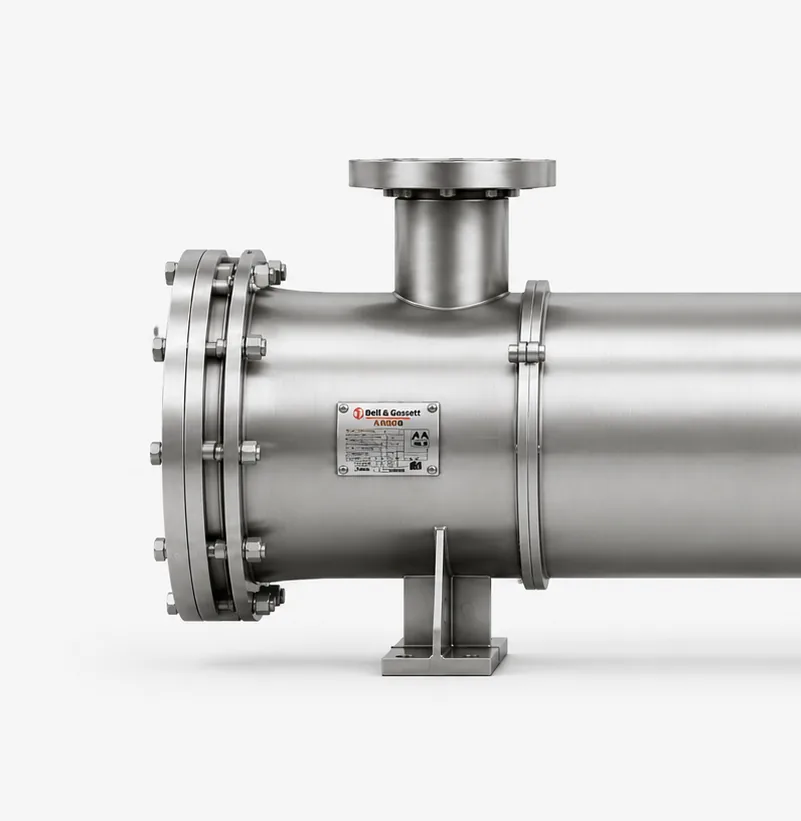
B&G Shell & Tube heat exchangers provide reliable, efficient heat transfer for a broad range of HVAC, commercial, and industrial applications. Engineered for dependable performance and long service life, they are well suited for heating, cooling, heat recovery, and process duties involving water, steam, glycol, and other compatible fluids. With multiple configurations, materials, and connection options available, B&G Shell & Tube heat exchangers can be selected to meet a wide variety of operating temperatures, pressures, flow rates, and installation requirements.
Request a Quote


What to Send With an Enquiry
Both fluids named rather than described, with flow rates, inlet temperatures and required outlet temperatures. Oil at ISO VG 46 behaves nothing like oil at VG 10, and a fifty percent glycol solution behaves nothing like water, so the fluid and its condition matter as much as the flow.
Then the mechanical envelope: design pressure and temperature on each side, and the connection sizes and arrangement if the unit has to fit existing pipework. Where a jurisdiction requires ASME construction, a registration number or double-wall construction for potable service, that belongs in the enquiry rather than the order.
The Design Point Is the Easy Part
What separates a good selection from a poor one is the range around it: turndown, seasonal variation in cooling water temperature, and what happens during startup or upset. A unit sized only on peak load can be badly controlled at the load it actually runs at for most of the year.
On steam duty in particular, the startup condensing rate is several times the running rate, and a trap sized for steady state will not keep up. Tell us the minimum load as well as the maximum.
Which Range Answers Which Duty
Steam on the shell side points at the SU, or the DSU where the water being heated is potable. Pumped liquid on both sides points at the WU, or the DWU for potable duty, with the compact CHX and CHXS covering small high-pressure loops at 300 PSI.
Beyond that the choice narrows quickly: OC for oil, GC for hot gas to 1000°F, aftercoolers for compressed air, HTWU where tube-side pressure exceeds the standard rating, and tank heater bundles where the fluid is stored rather than circulated.
Fouling Allowance Is a Decision, Not a Default
An over-generous allowance produces excess surface, which means lower velocity when the unit is clean, which encourages the very deposition the allowance was meant to cover. An absent allowance produces a unit that meets its duty on commissioning day and disappoints within a few seasons.
Your own water quality and cleaning history beat a table value every time. If you have performance records from existing units on the same water, send those too.