1-805-484-2992
Quotes - Engineering - SalesStorage Tank Heating
Recovery Rate, Not Standing Heat Loss
A storage tank and its heater are one system. The tank absorbs the peak draw; the heater brings it back to temperature before the next one. That arrangement lets a comparatively small heat input serve a building whose instantaneous demand would otherwise require a very large exchanger.
Three numbers size the bundle. Tank volume, the temperature rise required, and the time available to achieve it. Standing heat loss is negligible by comparison and sizing against it produces a heater that cannot recover the tank after a draw.
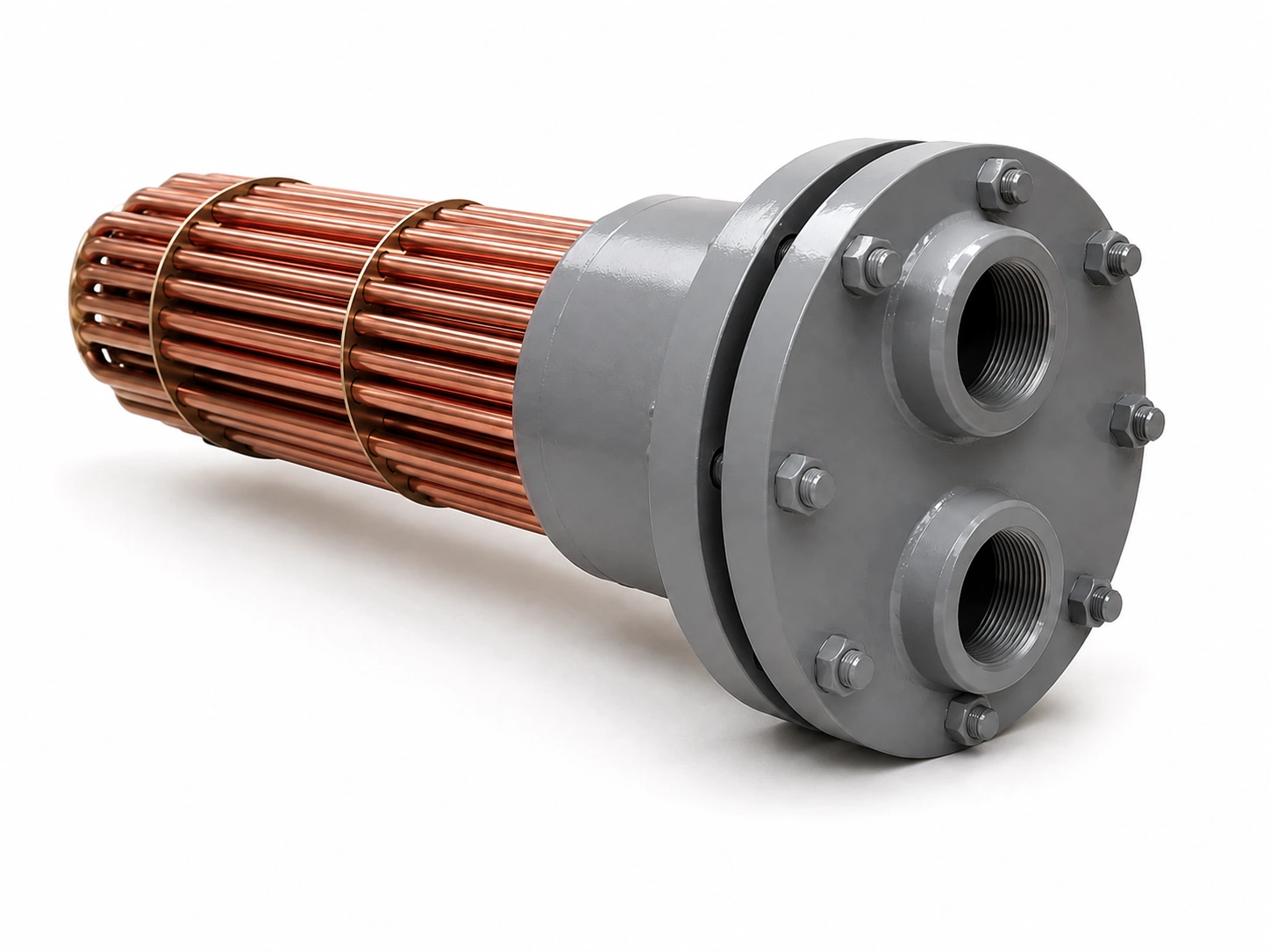
The bundle goes inside the tank. A TCS or TCW mounts on a flange bolted to a tank nozzle, with the heating medium in the tubes and the stored water surrounding them. There is no shell, because the tank is the shell.
Natural convection sets the size. With no forced circulation on the tank side, heat moves by convection driven only by density difference, and the resulting coefficient is low. That is why these bundles are long for their output and why the catalogued ranges extend to 120 inches.
Potable storage usually needs double-wall. Because the bundle sits inside the tank, a tube failure discharges the heating medium straight into stored drinking water. The DTCS and DTCW ranges exist for that case.
 Storage Tanks
 Steam Tank Heating
 Water Tank Heating
 Potable Storage
Storage Heating Selection
Tank volume, temperature rise and recovery time. Then the medium and whether double-wall is required.
Duty Inputs
- Tank volume: Gallons
- Temperature rise: Cold inlet to storage temperature
- Recovery time: Hours available
- Medium: Steam or hot water
Series
- TCS steam heated
- TCW water heated
- DTCS and DTCW for potable storage
- 2 pass throughout
- 4" to 14" bundle diameters
Check
- Nozzle size admits the bundle
- Clearance outside the tank to withdraw it
- Double-wall requirement
- Scaling from hard water
- Recirculation load if present
Sizing the Tank and the Bundle Together
Trade Tank Volume Against Recovery Rate
A larger tank with a smaller bundle and a smaller tank with a faster bundle can serve the same building. Which is better depends on the floor space available, the medium available and how sharp the draw profile is.
Where the peak is very short and very heavy, storage does most of the work. Where demand is more sustained, recovery rate matters more and the bundle gets larger.
Clearance Frequently Limits the Length
The bundle withdraws back through the nozzle it entered, so clear space outside the tank equal to the bundle length is required. In a plant room, against a wall or inside a bund, that space is often less than the thermal calculation would like.
Where it is genuinely tight, two shorter bundles in separate nozzles sometimes deliver the same surface in a serviceable arrangement.
Related