
1-805-484-2992
Quotes - Engineering - SalesBell & Gossett Heat Exchanger Gaskets
Head Gaskets, Tank Gaskets and Getting the Right One
Every removable-bundle exchanger seals in at least two places: between the bonnet and the tubesheet, and between the tubesheet and the shell flange. On multi-pass units the head gasket also carries a rib that seals the pass partition, and that rib is what makes the part specific to the pass arrangement rather than just to the shell size.
Pass arrangement is part of the specification. A two-pass head gasket and a four-pass head gasket for the same shell diameter are different parts, because the partition rib sits in a different place. Ordering by shell size alone is one of the more common ways the wrong gasket arrives.
Why the partition rib matters. If it leaks, tube-side fluid short-circuits from inlet to outlet without making the full circuit through the bundle. Duty falls, outlet temperature drifts, and nothing externally indicates a leak. It is among the hardest faults to diagnose and among the easiest to prevent.
Renew whenever the joint is opened. Gasket material takes a compression set that is not visible. Refitting one means relying on a seal that has already used most of its available deflection, and it will frequently hold at first and weep once the unit cycles.
Identify from the nameplate. The unit part number establishes shell diameter, length and pass arrangement, which is everything needed to produce the correct gasket list. Send a photograph of the nameplate rather than a measurement.
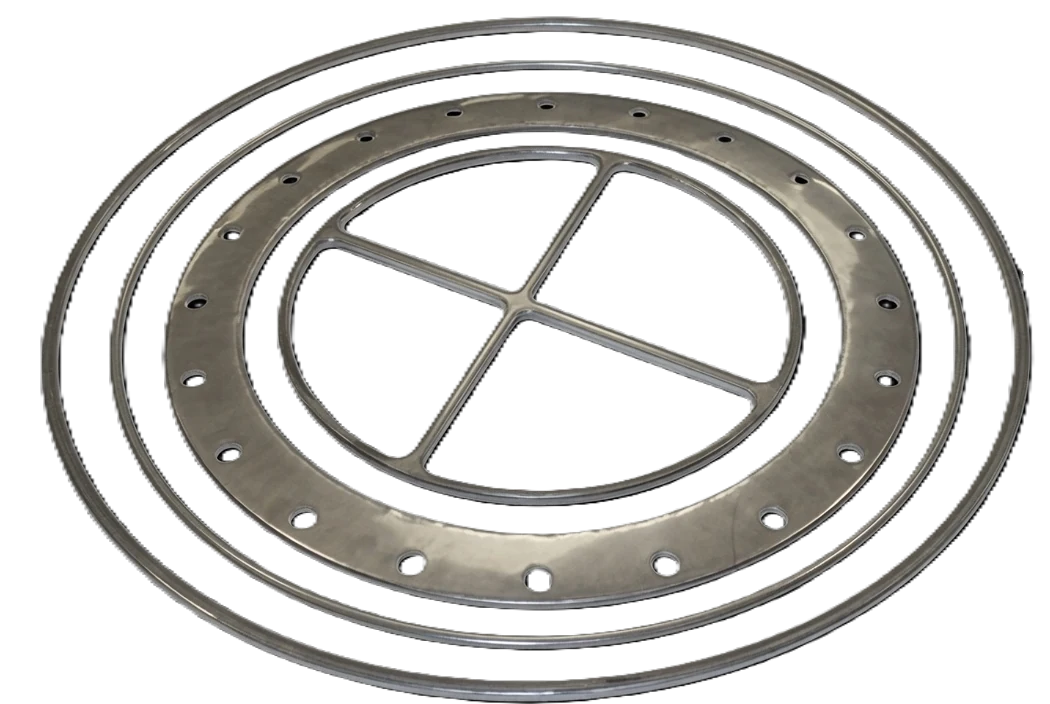
Gasket Selection
Gaskets are specific to the shell size and the pass arrangement. The unit part number establishes both.
Identified By
- Primary: Unit nameplate part number
- Shell size: Diameter and length
- Pass count: 2, 4 or 6 pass
- Position: Head or tank gasket
Common Errors
- Ordering by shell size alone
- Reusing a set that looks sound
- Mixing pass arrangements
- Measuring instead of reading the nameplate
- Fitting without checking torque sequence
Good Practice
- Renew whenever the joint is opened
- Keep a set on the shelf
- Record the part number on the shelf label
- Follow a crossing torque pattern
- Retorque after first heat-up
| PART TYPE | IDENTIFIED BY | VARIES WITH | SUPPLY |
| Gaskets | Unit part number | Shell size and pass count | Factory sourced |
Gasket Practice That Prevents Callbacks
Torque Sequence Is Not Optional
Bolted joints on a bonnet or tubesheet are tightened in a crossing pattern in stages, not around the circle in one pass. Tightening sequentially cocks the flange, loads one side of the gasket and leaves the other under-compressed.
That produces a weep that looks like a defective gasket and is actually an assembly error. It is the single most common reason a serviced exchanger leaks after being put back together.
Thickness Matters More Than Expected
A gasket of the correct material but the wrong thickness changes the compressed stack height, which changes the bolt load and can shift the axial position of the bundle relative to the shell.
Small position changes matter where nozzle-to-baffle alignment is tight. Using the specified part rather than a dimensional equivalent avoids a problem nobody will diagnose.
Common FAQs
From the unit part number on the nameplate. It establishes shell diameter, length and pass arrangement, which together determine the gasket. Measuring an old gasket is unreliable because the partition rib position matters as much as the outside dimension.
Yes. A multi-pass head gasket carries a rib that seals the pass partition, and that rib sits in a different position for a 2, 4 or 6 pass arrangement. Same shell size, different part.
No. Compression set is not visible. A gasket that looks perfect may have lost most of its recovery and will seal initially then weep once the unit cycles thermally.
Tube-side fluid bypasses from inlet to outlet without circulating through the bundle. Duty falls and outlet temperature drifts, with no external sign of a leak. It is difficult to diagnose and easy to prevent with the correct part and torque sequence.
Related

ACCESSORIES • BONNETS
Bonnets
Cast iron, cast brass and steel bonnets by series and size.
+ Learn More
CONFIGURATION • PASSES
Single Pass vs Multi-Pass
Why pass count changes the gasket you need.
+ Learn More