
1-805-484-2992
Quotes - Engineering - Sales
TCW Series
| PRODUCT | TYPE | STYLE | RATING |
|---|---|---|---|
| Heat Exchanger | Tank Heater | Tank Heater / Water | 150 PSI / 375°F |
Specifications
Configuration & Size
Shell Diameter:
4" to 14"
Shell Length:
12" to 120"
Tubes:
Copper
Passes:
2 Pass
Brand:
Bell & Gossett
Materials
- Bonnets: Cast Iron or Cast Brass
- Shell: Steel
- Tubes: Copper
- Tubesheet: Steel or Brass
TCW Series Water Tank Heaters
Heating Tank Contents Without an External Loop
Some fluids should not be pumped out to an exchanger and back. They are stored rather than circulated, the volume is large relative to the flow, or adding a pump and pipework to a tank that already exists is unwelcome. A tank heater puts the heat transfer surface into the tank instead.
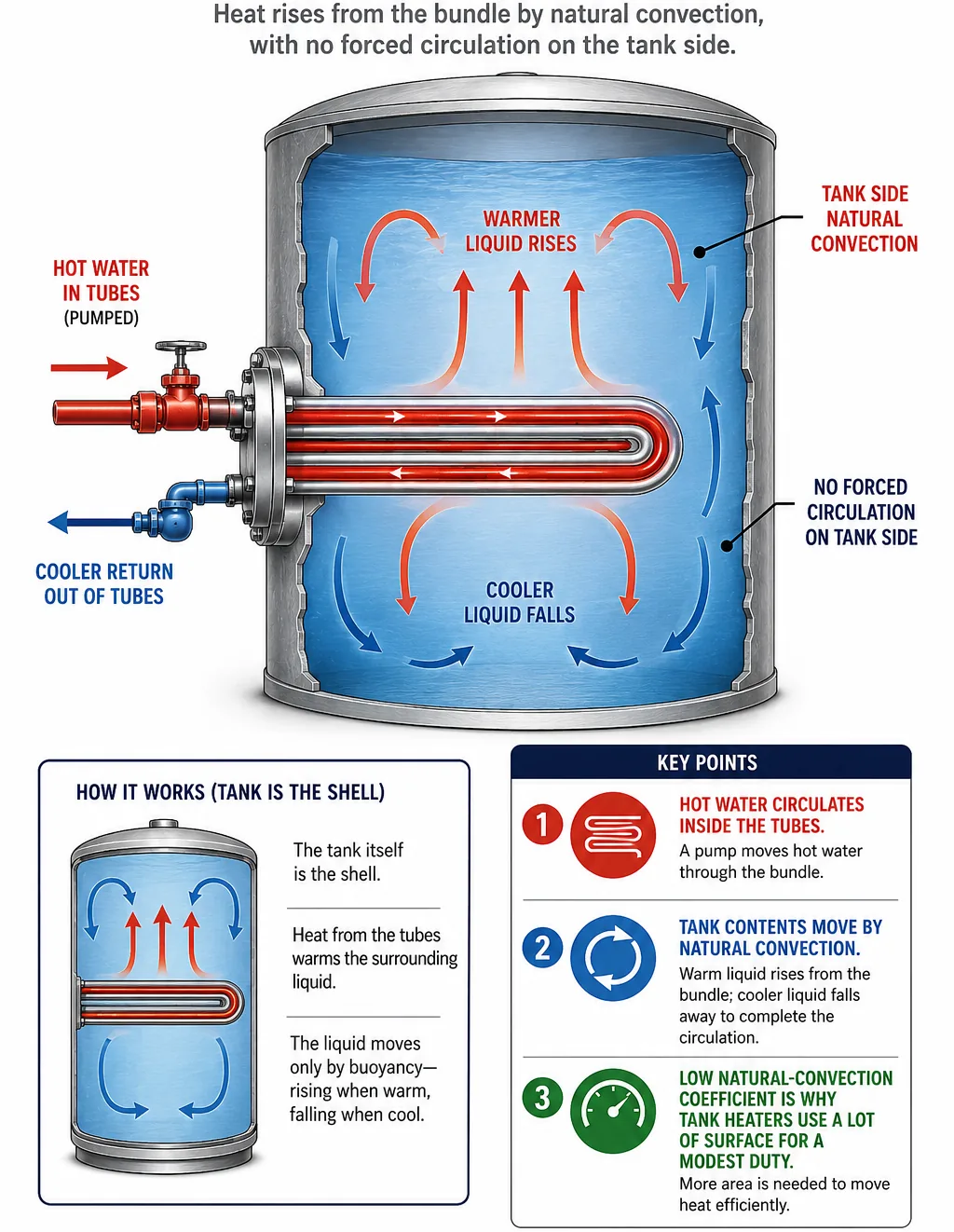
How it works. The bundle mounts on a flange that bolts to a tank nozzle. Hot water circulates through the tubes; the tank contents surround them. There is no shell in the usual sense, because the tank is the shell.
Natural convection sets the size. Most tank heating has no forced circulation on the tank side, so heat moves by natural convection and the coefficient is low. That is why tank heaters carry a lot of surface for a modest duty, and why the catalogued range extends to 120 inch lengths.
Storage water heating is the classic duty. A TCW in a storage tank, fed by a boiler loop, is one of the standard ways to make domestic hot water in a commercial building. The tank provides the buffer, the heater provides the recovery rate, and the two are sized together.
Removal clearance matters. The bundle withdraws back through the nozzle it entered, so you need clear space outside the tank at least equal to the bundle length. On a tank in a plant room or against a wall, that is worth confirming before the order rather than at the first service.
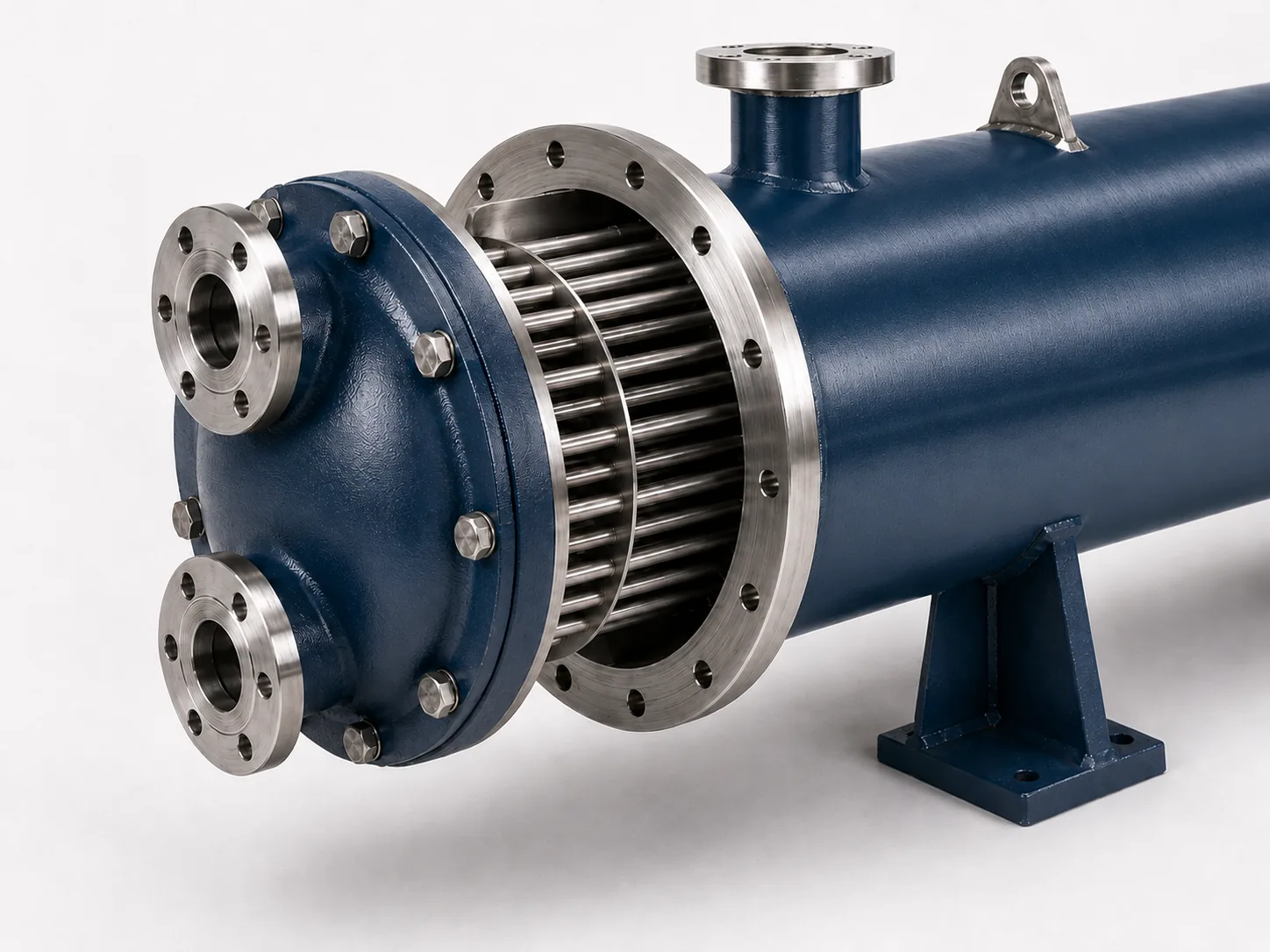
Mounts through a tank nozzle on a single flange, with pumped hot water through the tubes.
Request a QuoteTCW Series Applications


Natural Convection Is Why the Bundle Is Long
A tank heater has no shell of its own, because the tank is the shell. What it also has, in most installations, is no forced circulation on the tank side at all. Heat moves away from the tubes by natural convection alone, driven only by the density difference between warmed and unwarmed fluid, and the resulting film coefficient is a small fraction of what a pumped exchanger achieves.
The bundle compensates with surface area, which is why catalogued lengths run to 120 inches for duties an external exchanger would handle in a fraction of the space. It is not over-specification; it is the arithmetic of a low coefficient. Where a tank does have an agitator, a mixer or a circulation loop, the coefficient improves considerably and the required bundle gets noticeably shorter, so it is always worth telling us.
Size on recovery rather than standing loss. Tank volume, the temperature rise required, and the time available to achieve it are the three numbers that matter; a tank's standing heat loss is negligible by comparison and sizing against it produces a heater that holds temperature perfectly and cannot recover after a draw. Call and talk it through with an engineer: 1-805-484-2992