
1-805-484-2992
Quotes - Engineering - SalesHydronic Heating Circuits
Separating One Water Loop From Another
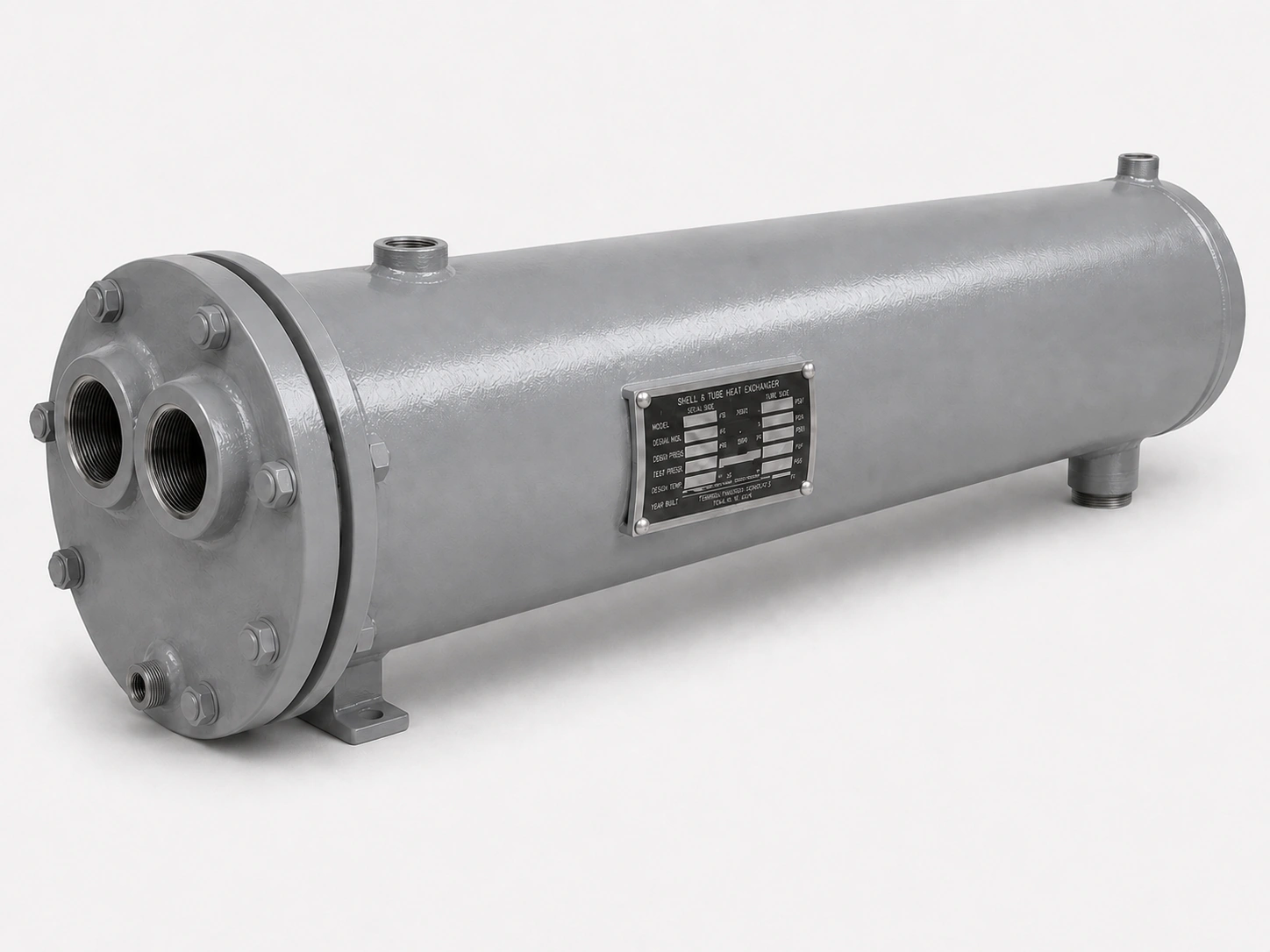
A liquid-to-liquid exchanger in a hydronic system almost never exists because the temperatures demand it. It exists to separate circuits: to keep a high-pressure riser away from low-pressure terminal equipment, to isolate a glycol loop from clean building water, to divide a campus main from a building's internal distribution, or to protect a boiler from a system it cannot tolerate.
Both sides are pumped, so both sides matter. Unlike steam duty, neither side dominates the design automatically. Flow rate, allowable pressure drop and fouling on each side all feed into the selection, and omitting the pressure drop on either side is the most common reason a selection has to be redone.
Approach temperature is the cost of separation. Every exchanger inserted into a circuit consumes some temperature difference, and in a hydronic system that difference is usually modest to begin with. A close approach keeps the penalty small, which matters more here than on a steam duty where there is plenty of driving force to spare.
Static head is the constraint people miss. In a tall building the bottom of a riser can sit well above 150 PSI on static head alone. The HTWU range carries a 400 PSI tube-side rating for exactly that case, at standard lead times rather than as an engineered build.
Water quality drifts over a building's life. Make-up gets added, treatment lapses, and the shell side eventually needs cleaning. A removable bundle and clearance to withdraw it are what make that a maintenance task rather than a replacement.
 Heating Loops
 Pressure Zones
 Glycol Separation
 Terminal Equipment
Hydronic Selection
Both circuits have to be specified. Flow, temperatures and allowable pressure drop on each side.
Duty Inputs
- Both flows: GPM each side
- Both temperatures: In and out each side
- Pressure drop: Allowable each side
- Static head: At the exchanger
Series
- WU for general duty
- CHX and CHXS for small loops at 300 PSI
- HTWU where static head exceeds 150 PSI
- DWU where one side is potable
- 2, 4 and 6 pass available
Why Separate
- High-rise pressure zones
- Glycol from clean water
- Campus main from building loop
- Boiler protection
- Terminal equipment rating
Hydronic Design Points
Send the Pressure Drop, Not Just the Duty
An exchanger can meet the thermal requirement precisely and still be the wrong unit, because the pump cannot push the design flow through it. On liquid-to-liquid duty that happens more often than on steam, because there are two circuits and two pumps to satisfy.
If the pumps are already installed and fixed, send the curves. They constrain the velocity we can design for, which in turn constrains the plate count and pass arrangement.
Fouling Allowance Deserves Thought
Building water quality is rarely as good as the design assumed and it gets worse as make-up is added over the years. An exchanger sized with no fouling margin will meet its duty on commissioning day and disappoint within a few seasons.
The opposite error also exists. An over-generous allowance produces excess surface, which means lower velocity when the unit is clean, which encourages the very deposition the allowance was meant to cover.
Related
APPLICATION • BOILER
Boiler Isolation
The most common reason to separate two water circuits.
+ Learn More