1-805-484-2992
Quotes - Engineering - SalesEngine Jacket Water Cooling
Holding a Narrow Temperature Band
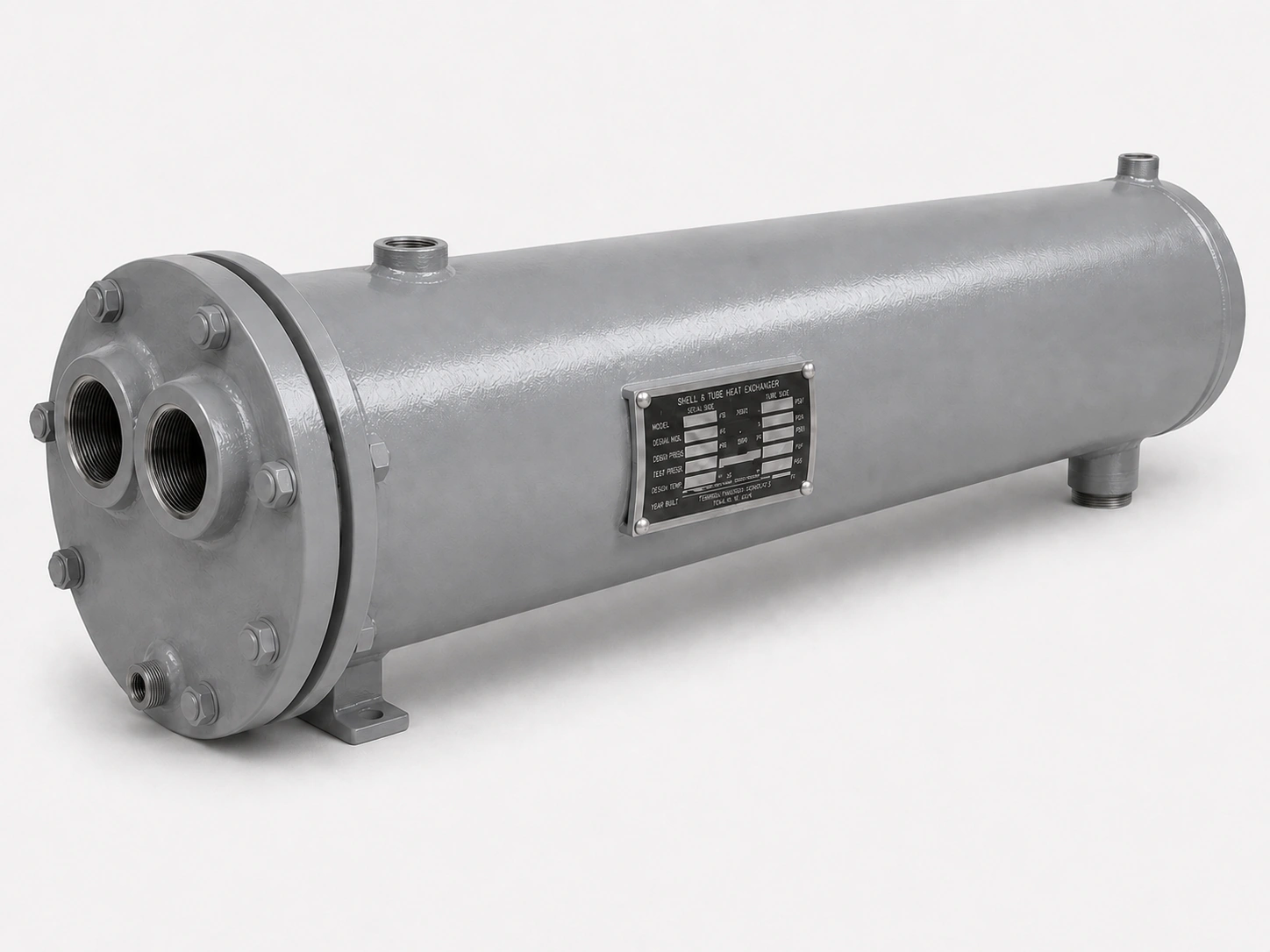
Engine jacket water has to stay within a band the manufacturer specifies. Too cold and combustion suffers and condensation forms in the crankcase; too hot and the engine is at risk. A shell and tube exchanger between the jacket circuit and the site cooling water holds that band while keeping the engine's treated coolant separate from whatever the site supplies.
Isolation is the point. Engine coolant carries a specific inhibitor package and is expensive to make up. Site cooling water is frequently untreated. Keeping the two apart protects the engine and lets the site water be as poor as it is.
Standby engines are a different duty from continuous ones. A generator on standby starts under load from cold and reaches full heat rejection within minutes, then may run for hours or stop. That is a thermal cycling duty, and it is exactly what U-tube construction absorbs without an expansion joint.
Approach temperature sets the achievable jacket temperature. The engine cannot be cooled below the site water temperature plus the exchanger approach. Where site water is warm, a close approach is what keeps the engine inside its band on the hottest day of the year.
Site water quality decides the maintenance interval. Put it on the shell side where the bundle can be withdrawn and the surface cleaned, and specify clearance to do it.
 Jacket Water
 Lube Oil Cooling
 Generator Sets
 Site Water Isolation
Jacket Water Selection
Engine heat rejection, the jacket temperature band and the site water available.
Duty Inputs
- Heat rejection: BTU/hr from the engine data
- Jacket temperatures: In and out limits
- Jacket flow: GPM from the engine pump
- Site water: Flow and summer supply temperature
Series
- WU for general jacket duty
- CHXS for small engines at 300 PSI
- OC for lubricant cooling
- Sized on summer site water
- Removable bundle for service
Duty Profile
- Continuous prime power
- Standby generator
- Peak shaving operation
- Cogeneration heat recovery
- Cyclic and start-stop
| DUTY | TYPICAL SERIES | ISOLATES | OPERATION |
| Jacket Water | WU / CHXS | Engine from site water | Continuous or standby |
Size on the Worst Day, Not the Average
Summer Site Water Is the Design Case
An engine cannot be cooled below the site water temperature plus the exchanger approach. On the hottest day of the year, with the warmest cooling water the site can supply, that sum has to still be inside the engine's jacket temperature limit.
Sizing on an annual average or a spring measurement produces an installation that derates or trips in August. Use the worst credible site water temperature.
Standby Duty Is Thermal Cycling
A standby generator sits cold for weeks, then starts under load and reaches full heat rejection within minutes. Each start is a thermal shock, and over years those cycles accumulate.
A U-tube bundle expands freely with no expansion joint to fatigue, which is why it suits this duty better than a fixed tubesheet unit would.
Related