
1-805-484-2992
Quotes - Engineering - Sales
WU Series
| PRODUCT | TYPE | STYLE | RATING |
|---|---|---|---|
| Heat Exchanger | Shell & Tube | Liquid-to-Liquid | 150 PSI / 300°F |
Specifications
Configuration & Size
Shell Diameter:
4" to 30"
Shell Length:
36" to 144"
Tubes:
3/4" O.D. Copper
Passes:
2, 4 and 6 Pass
Brand:
Bell & Gossett
Materials
- Bonnets: Cast Iron or Cast Brass
- Shell: Steel
- Tubes: Copper
- Tubesheet: Steel or Brass
WU Series Liquid-to-Liquid Heat Exchangers
Pumped Water in the Shell, Process Fluid in the Tubes
The WU is arranged for pumped liquid on both sides. Boiler water circulates through a baffled shell while the heated or cooled fluid passes through a removable U-tube bundle. Because both streams are pumped, shell-side velocity is a design variable rather than something the steam decides for you, which is why the shell carries baffles the SU does not need in the same way.
Both sides matter to the sizing. On a steam unit the condensing coefficient is so high that the water side controls. On a liquid-to-liquid unit neither side dominates automatically, so flow rate, allowable pressure drop and fouling on both sides all feed into the selection. Sending us only the tube-side conditions leaves half the problem unstated.
The classic applications are steady rather than dramatic. Pool and storage tower heating, condensate cooling, oil cooling and snow melting all appear in the catalogue descriptions, and they share a profile: modest temperature differences, long run hours and a strong preference for equipment that can be cleaned rather than replaced.
Free thermal expansion still earns its place. Even without steam, a liquid-to-liquid unit sees startup transients, seasonal swings and the occasional upset. The U-bundle absorbs all of it with no expansion joint to fatigue, and the bundle withdraws for shell-side cleaning when the water quality eventually leaves a deposit.
Part numbers and legacy designations. The 5-265 and 5-266 catalogue ranges cover the WU, and the older WU85-2 style designation describes the same units. Either form on a nameplate is enough to identify the unit, its shell dimensions and its pass arrangement.
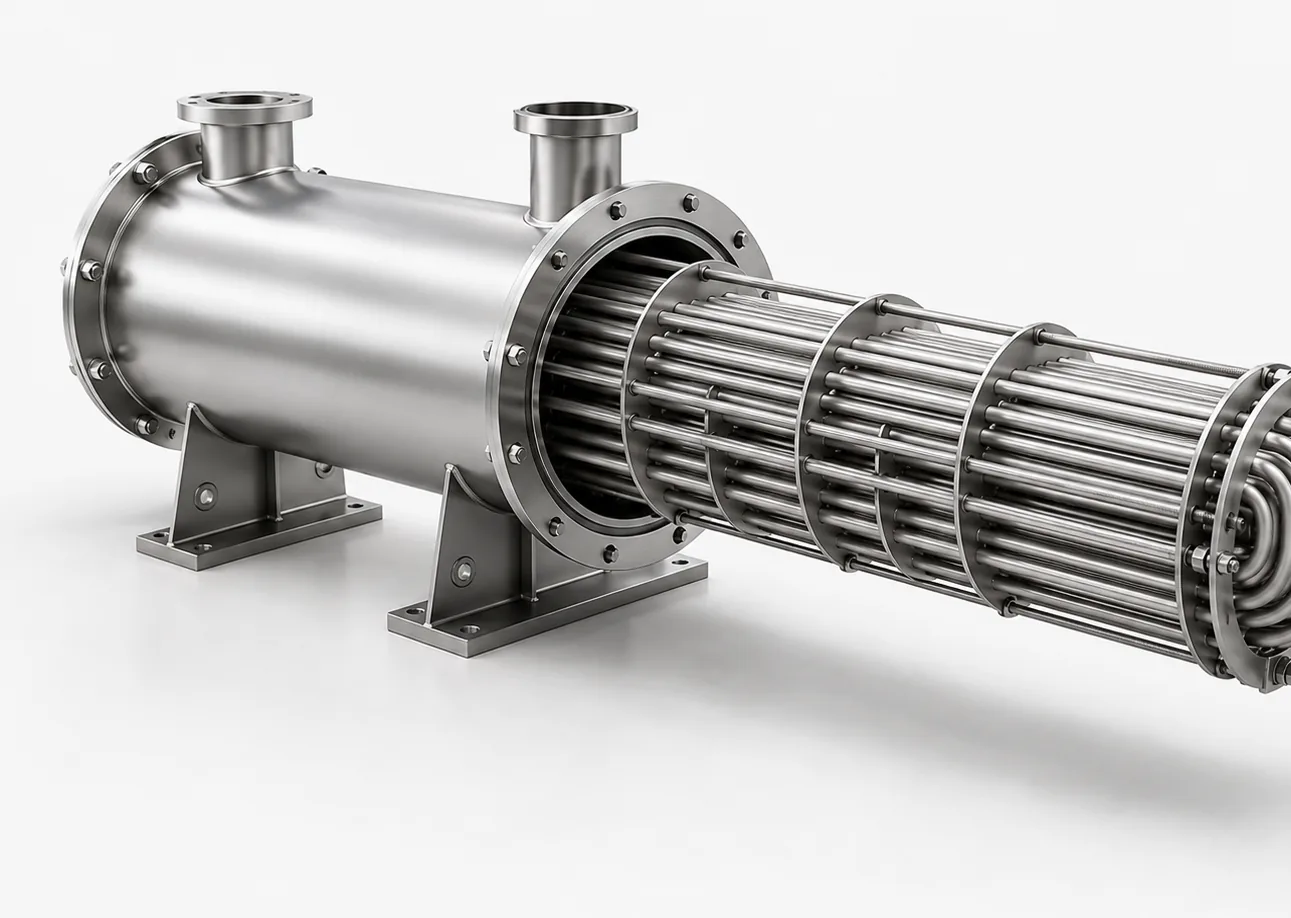
Pumped liquid on both sides through a baffled shell and a removable U-tube bundle. Shells from 4 to 30 inches.
Request a QuoteWU Series Applications




Why the Shell Side Is Baffled
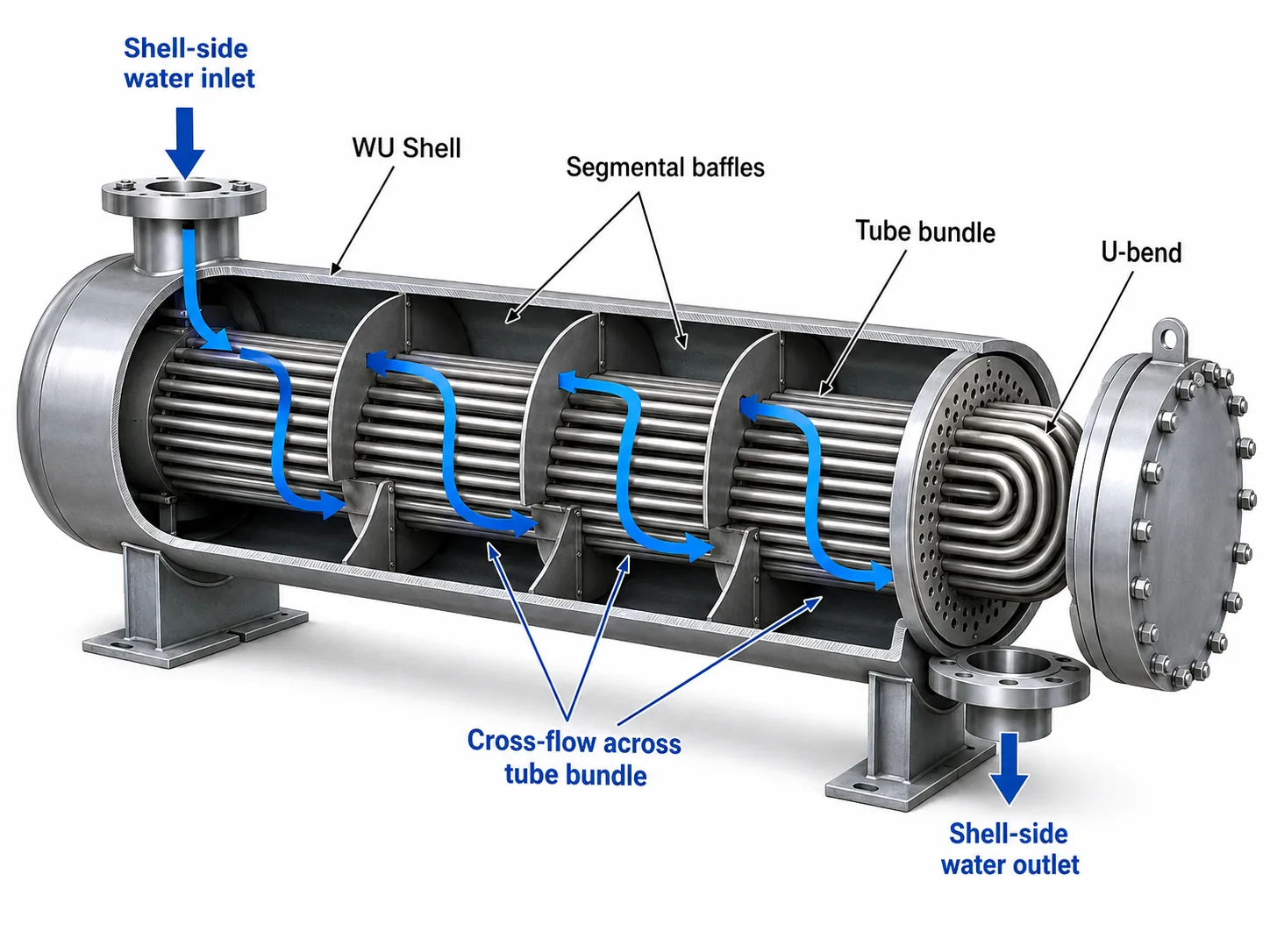
On a steam unit the shell side looks after itself: steam fills the shell, condenses at essentially constant temperature, and the water side controls the design. On a liquid-to-liquid unit nothing looks after itself. Pumped water entering an unbaffled shell would run straight from inlet to outlet along the path of least resistance, leaving most of the bundle doing very little.
Baffles force that flow back and forth across the tubes instead. They raise shell-side velocity, they create cross flow rather than parallel flow, and between them those two effects transform the shell-side coefficient. They also cost pressure drop, which is why baffle spacing is a design decision rather than a constant, and why the shell-side pressure drop you can afford is genuinely part of the specification.
This is the practical reason a WU enquiry needs both sides stated. Flow rate, inlet and required outlet temperature, and allowable pressure drop, for each circuit. Sending only the tube-side conditions leaves half the problem unstated, and the half that is missing is the one that sets the baffle arrangement. Call and talk it through with an engineer: 1-805-484-2992