1-805-484-2992
Quotes - Engineering - SalesSnow Melt System Heat Exchangers
Glycol Loops That Sit Idle Then Run Hard
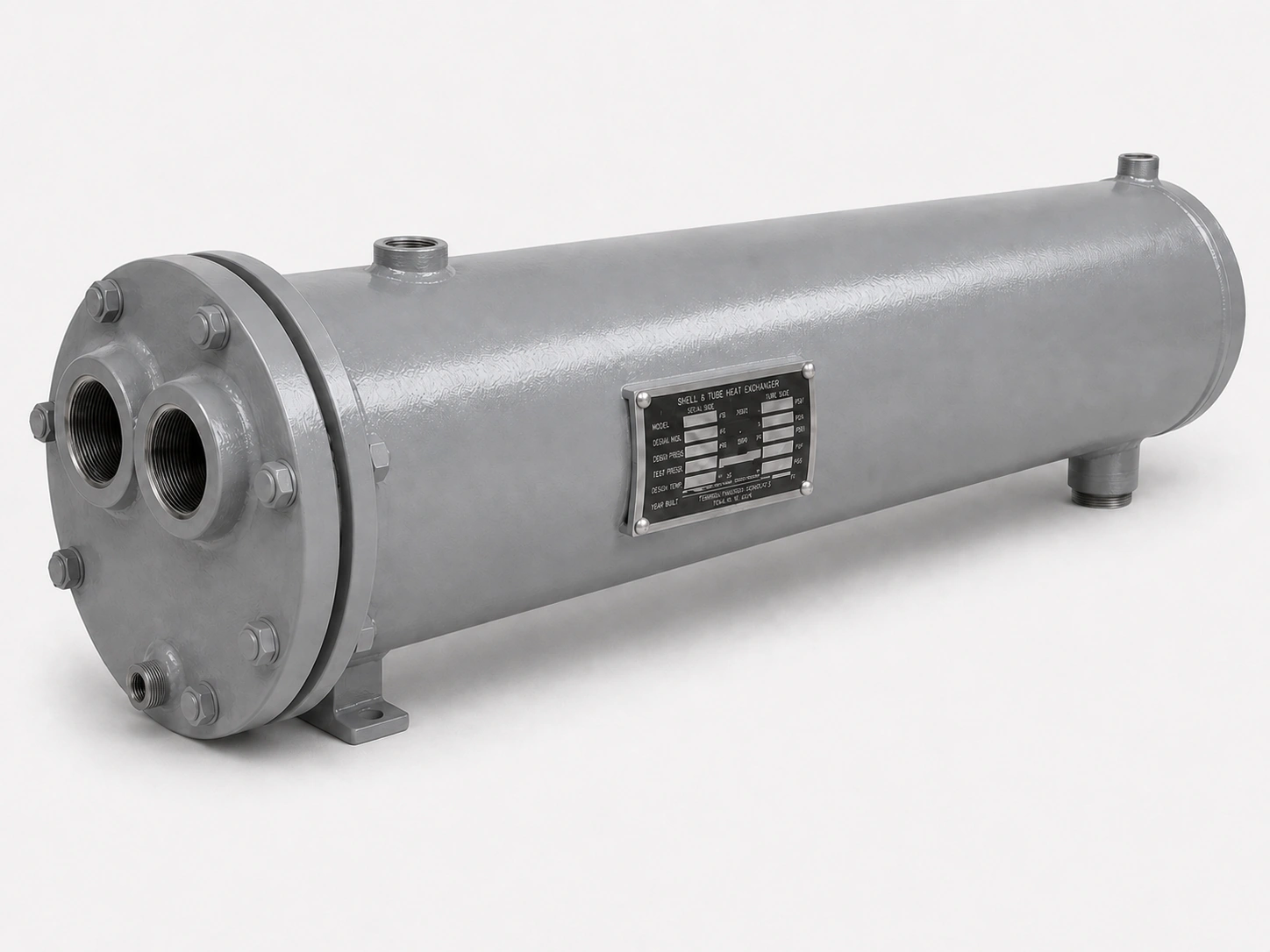
A snow melt system circulates glycol through tubing embedded in a driveway, walkway, ramp or loading dock, and a heat exchanger separates that glycol from the building's boiler water. The separation is not optional: the glycol volume is large, it is exposed to freezing ambient, and it must never mix with the building circuit.
Glycol is not water with antifreeze in it. It is more viscous, less thermally conductive and has a lower specific heat. All three work against the duty simultaneously, and the shortfall on a loop sized as though it were water is larger than most people expect.
Size for the cold start, not the operating point. Glycol viscosity rises steeply as temperature falls, and a snow melt loop starts from ambient in a snowstorm. A circuit comfortably turbulent at operating temperature can be laminar at startup, and once flow goes laminar the coefficient collapses and the slab takes far longer to respond than the calculation predicted.
The duty profile is brutal. The system sits idle for weeks then runs at full output for hours. That is thermal cycling of the kind a fixed tubesheet unit needs an expansion joint to survive, and a U-tube bundle absorbs without one.
Concentration should be the minimum the site requires. Every percentage point of glycol above what the freeze protection genuinely needs costs heat transfer and pumping power permanently. Set it to the design low temperature and monitor it, because it drifts as make-up is added.
 Glycol Loops
 Slab Heating
 Freeze Protection
 Intermittent Duty
Snow Melt Selection
The slab area and the design snowfall rate set the load. The glycol properties at startup set the exchanger.
Duty Inputs
- Slab area: Square feet to be melted
- Design conditions: Ambient and snowfall rate
- Glycol type: Ethylene or propylene
- Concentration: Percentage by volume
Series
- WU for the isolation duty
- Sized on glycol properties, not water
- Checked at cold startup
- 2, 4 and 6 pass available
- Removable bundle for service
Design For
- Cold start viscosity
- Intermittent full load
- Thermal cycling
- Minimum glycol concentration
- Slab response time expected
| DUTY | TYPICAL SERIES | LOOP FLUID | OPERATION |
| Snow Melt | WU | Glycol | Intermittent, full load |
Snow Melt Is a Cold Start Problem
The Calculation That Matters Is at Startup
A snow melt system is judged on how quickly the slab clears, and that happens at the worst possible condition for glycol: everything at ambient, viscosity at its highest, and the coefficient at its lowest. Sizing on the operating point flatters the design considerably.
Check the design at the coldest realistic starting condition, with the glycol properties at that temperature. It frequently moves the selection up a size, and it is the difference between a system that responds and one that disappoints in its first winter.
Concentration Discipline Pays Every Hour
Loops are routinely over-concentrated on the theory that more antifreeze must be safer. It is not: every point above the requirement costs heat transfer and pumping power for the life of the system, and it makes the cold start worse.
Establish the design low temperature, set the concentration to protect against it with a modest margin, and check it periodically. It drifts as make-up water is added.
Related
SERIES • LIQUID
WU Series
The general-purpose liquid-to-liquid range for the isolation duty.
+ Learn More