1-805-484-2992
Quotes - Engineering - SalesDouble-Wall Protection
Turning a Silent Failure Into a Visible One
A single-wall tube separates two fluids with one barrier. If it develops a pinhole, the higher-pressure fluid crosses into the lower-pressure one, and nothing about the exchanger announces it. The failure is discovered by a water quality test, a taste complaint, or a chemical analysis, all of which happen well after the event.
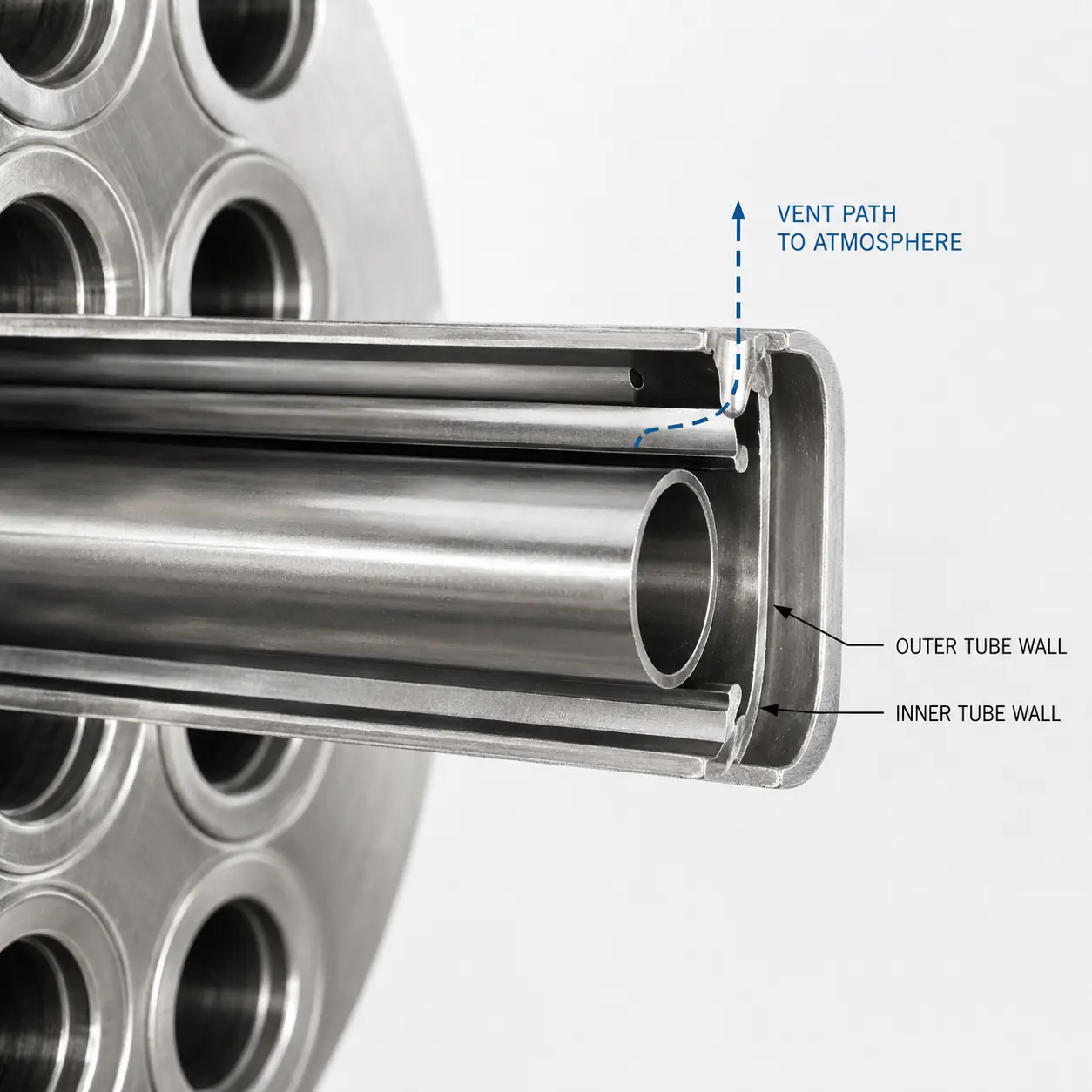
Double-wall construction interposes a vented gap. Two tubes are drawn together so their walls are in intimate mechanical contact for heat transfer. Between them runs a deliberate path to the tube end, outside the pressure boundary of either fluid. A leak through either wall discharges there, visibly, and does not cross between streams.
Decide on consequence, not probability. Tube failures are uncommon. The question is what happens if one occurs and goes unnoticed for a week. Where the answer involves drinking water in an occupied building, a food product or a regulated process, the arithmetic favours double-wall regardless of how reliable a single tube is.
Where it is not warranted. A closed glycol loop interchanging against tower water in a plant room does not need it. Both fluids are already non-potable and a cross-leak is a maintenance matter, not a safety one. Specifying double-wall there adds surface and cost for a consequence nobody would notice.
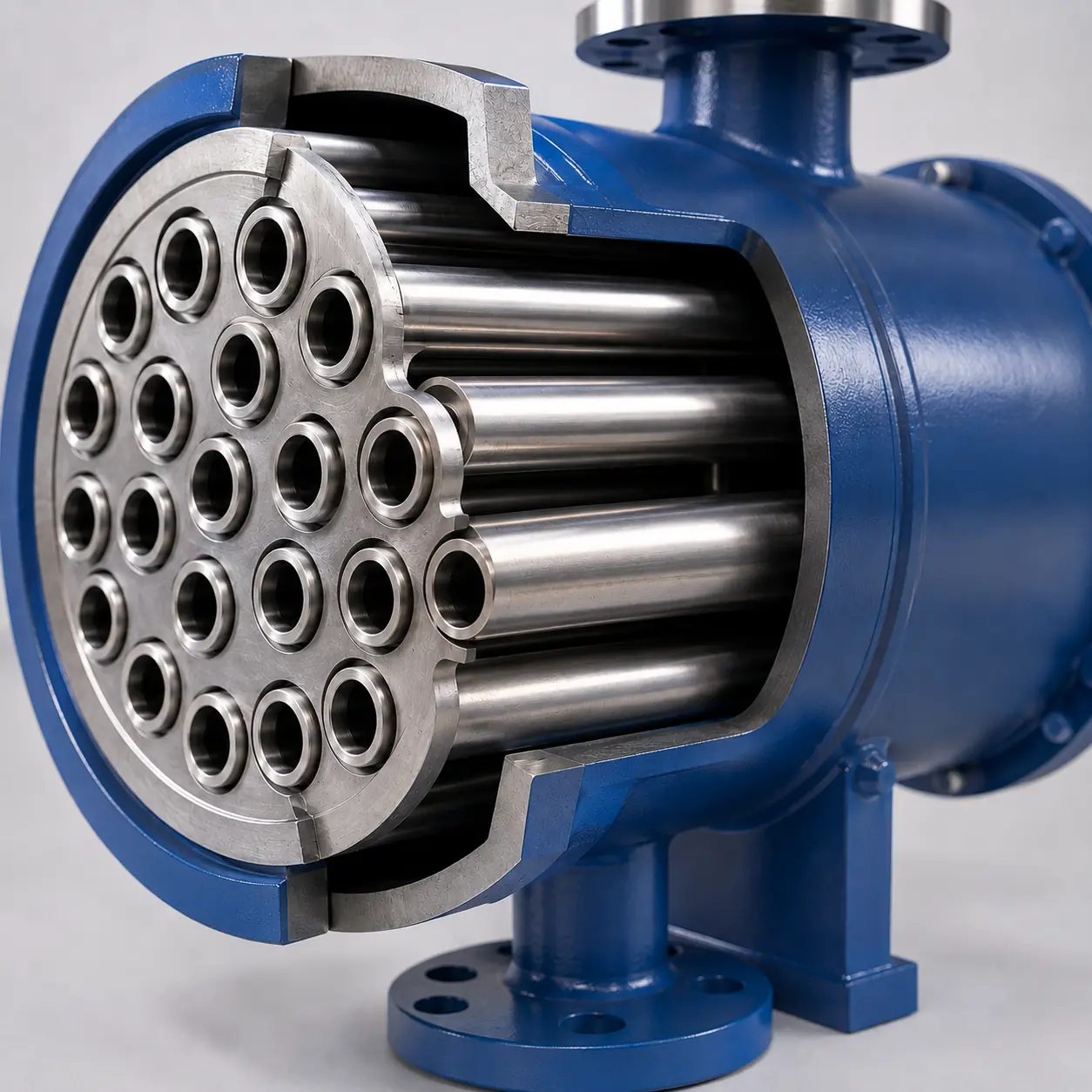
Four ranges provide it. DSU for steam-to-liquid, DWU for liquid-to-liquid, and DTCS and DTCW for steam and water heated tank bundles respectively. All four use naval brass tubesheets on the shell and tube ranges and carry separate catalogue number series.
 Boiler Water
 Domestic Water
 Glycol-to-Water
 Refrigerant Cooling
Double-Wall Construction
Two tube walls, a vented path between them, and naval brass tubesheets on the shell and tube ranges.
Construction
- Tube walls: Two, in intimate contact
- Vent path: To the tube end, external
- Tubesheet: Naval brass on DSU and DWU
- Bundle: Removable U-tube
Ranges
- DSU steam-to-liquid
- DWU liquid-to-liquid
- DTCS steam tank heater
- DTCW water tank heater
- Separate catalogue number series
Specify It When
- Potable water is being heated
- A food product is on one side
- A regulated process is involved
- The local code requires it
- A silent cross-leak is unacceptable
What Double-Wall Costs and What It Buys
It Costs Surface Area
The interface between the two tube walls is a real thermal resistance, however intimate the contact. A double-wall unit therefore needs more surface than a single-wall unit for the same duty, and it is physically larger.
That shows up in the catalogued ranges: the DSU and DWU top out at 12 inch shells where the SU and WU continue to 30. On a duty near the top of the double-wall range, the alternative is two units rather than one.
It Is Not a Retrofit
Tube construction, tube count, tubesheet material and the vent arrangement all differ between single-wall and double-wall ranges. A duty that comes to require double-wall protection requires a double-wall unit.
Part numbers do not cross over, and ordering by dimension is how the wrong unit arrives. Quote the requirement, not the size.
Related

APPLICATION • POTABLE
Potable Water Heating
The duty that most often triggers the requirement.
+ Learn More
CONSTRUCTION • U-TUBE
Double-Wall U-Tube
How the construction works in the shell and tube ranges.
+ Learn More